Übergang: Aufrollen
Das alte Bild rollt sich von der Ecke her zu einer Rolle auf, die wächst, durchs Bild läuft und es verlässt. Ein flach umgeklappter Lappen liest sich nur als schrumpfendes Dreieck; erst die Rolle wirkt wie Papier. Die Oberfläche kommt aus einem `warpGrid`-Gitter, die Rundung aus Canvas-Verläufen.
A
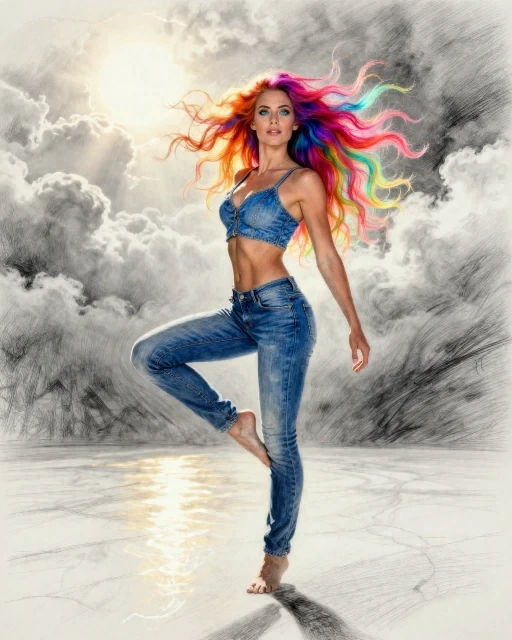
B
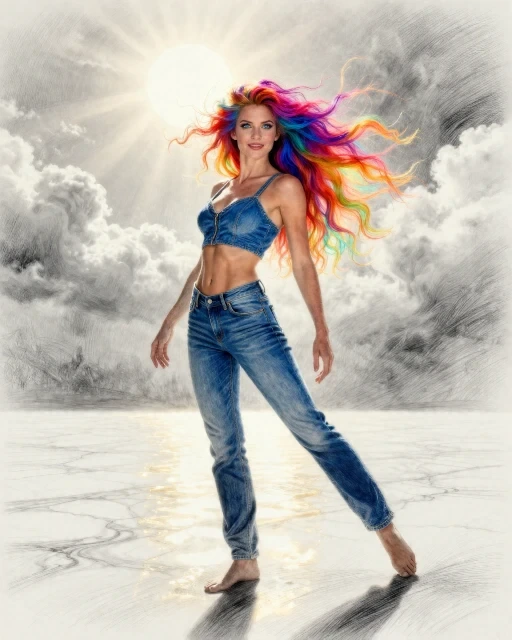
Animation
JavaScript
// Roll up — one transition between two photos, exported as a looping animated WebP.
//
// Everything specific sits in transition(from, to, T): it takes two images it may change and a
// progress T from 0 to 1, and returns one new frame. Video tools can call exactly that for each
// frame of a cut; the rest of this script only builds the animation.

//!INPUT: A, B
//!OUTPUT: OUT
//!PARAM: STEPS:integer=18,min=2,max=120
//!PARAM: DELAY_MS:integer=50,min=10,max=2000
//!PARAM: HOLD_MS:integer=700,min=0,max=5000
//!PARAM: RADIUS:number=34,min=8,max=300,step=2
//!PARAM: PAPER:string=auto

function transition(from, to, T) {
  if (T <= 0 || T >= 1) {
    (T <= 0 ? to : from).free();
    return T <= 0 ? from : to;
  }
  const w = to.width, h = to.height;
  // Corner at the bottom right; n points from it to the centre, s is the distance along n.
  const ox = w, oy = h;
  const nl = Math.hypot(w / 2 - ox, h / 2 - oy);
  const nx = (w / 2 - ox) / nl, ny = (h / 2 - oy) / nl;
  const smax = w * Math.abs(nx) + h * Math.abs(ny);
  const start = RADIUS * 0.25;
  // f: where the roll touches. It starts fully outside and rolls fully out at the end.
  const f = -start + (T * T * (3 - 2 * T)) * (smax + RADIUS + start);
  // The more is rolled up, the thicker the roll: Its area grows with the length.
  const rolled = Math.min(1, Math.max(0, f) / smax);
  const r = Math.sqrt(start * start + (RADIUS * RADIUS - start * start) * rolled);

  const L = 2 * (w + h), tx = -ny, ty = nx;
  const at = (s, t) => `${ox + nx * s + tx * t},${oy + ny * s + ty * t}`;
  const bandPath = (a, b) => `M ${at(a, -L)} L ${at(a, L)} L ${at(b, L)} L ${at(b, -L)} Z`;
  const point = (s) => px(ox + nx * s, oy + ny * s);

  // White where a <= s <= b.
  const band = (a, b) => {
    const cv = Engine.createCanvas(w, h);
    cv.fill("#000").drawPathStr(`M 0,0 L ${w},0 L ${w},${h} L 0,${h} Z`);
    cv.fill("#fff").drawPathStr(bandPath(a, b));
    const mask = cv.toImage();
    cv.free();
    return mask;
  };
  // A gradient across the roll, laid over what is there.
  const gradient = (a, b, colors, stops) => {
    const cv = Engine.createCanvas(w, h);
    cv.linearGradient(point(a), point(b), colors, stops);
    cv.drawPathStr(bandPath(a, b));
    const image = cv.toImage();
    cv.free();
    to.blendAt(image, px(0, 0), 1, Blend.Over);
    image.free();
  };

  // The part of the old image still lying flat.
  const flatMask = band(f, 1e5);
  const flat = from.clone().applyMask(flatMask);
  to.blendAt(flat, px(0, 0), 1, Blend.Over);
  flat.free();
  flatMask.free();

  // Shadow of the roll on both images.
  gradient(f - r * 1.6, f - r * 0.8, ["#00000000", "#00000080"], [0, 1]);
  gradient(f + r * 0.8, f + r * 1.4, ["#00000080", "#00000000"], [0, 1]);

  // Paper to suit the image: A white sheet glares on a dark one.
  const mean = from.clone().resize(1, 1);
  const c = mean.getPixel(px(0, 0));
  mean.free();
  const isDark = 0.2126 * c.r + 0.7152 * c.g + 0.0722 * c.b < 0.35;
  const paper = PAPER !== "auto" ? PAPER : isDark ? "#2b3038" : "#f4f4f2";

  // The roll shows the back of the sheet. What lies on top came round the arc from the point of
  // contact, so the pattern travels with the movement.
  const STEP = 6;
  const cols = Math.ceil(w / STEP) + 1, rows = Math.ceil(h / STEP) + 1;
  const nodes = [];
  for (let i = 0; i < rows; i++) {
    const row = [];
    for (let j = 0; j < cols; j++) {
      const x = (j / (cols - 1)) * w, y = (i / (rows - 1)) * h;
      const s = (x - ox) * nx + (y - oy) * ny;
      const angle = Math.asin(Math.min(1, Math.max(-1, (s - f) / r)));
      const across = s - (f - r * (Math.PI + angle));
      row.push((x - nx * across) / w, (y - ny * across) / h);
    }
    nodes.push(row);
  }
  const skin = from.warpGrid({ rows, cols, nodes, border: WarpBorder.Transparent });
  skin.tint(paper, 0.82);
  const roll = Engine.createColoredImage(w, h, paper);
  roll.blendAt(skin, px(0, 0), 1, Blend.Over);
  const rollMask = band(f - r, f + r);
  roll.applyMask(rollMask);
  to.blendAt(roll, px(0, 0), 1, Blend.Over);
  roll.free();
  rollMask.free();

  // Light and roundness: dark edges, the highlight a little towards the light.
  gradient(
    f - r,
    f + r,
    ["#00000099", "#00000033", "#ffffff2e", "#00000026", "#000000a6"],
    [0, 0.18, 0.42, 0.72, 1],
  );
  from.free();
  return to;
}

const imgA = Engine.loadImage(A);
const imgB = Engine.loadImage(B);
if (imgB.width !== imgA.width || imgB.height !== imgA.height) {
  imgB.resize(imgA.width, imgA.height);
}
const anim = Engine.animation(imgA.width, imgA.height, { loop: 0 });
const p = Engine.progress("Transition frames", { total: STEPS * 2 });

// There and back: the loop closes without a jump, and both directions show the effect.
for (const [first, second] of [[imgA, imgB], [imgB, imgA]]) {
  for (let i = 0; i < STEPS; i++) {
    const T = i / (STEPS - 1);
    const frame = transition(first.clone(), second.clone(), T);
    anim.addFrame(frame, { delay: i === STEPS - 1 ? HOLD_MS : DELAY_MS });
    frame.free();
    p.step(1, `frame ${i + 1}/${STEPS}`);
  }
}

anim.saveWebP(OUT, { lossy: true, quality: 62 });
anim.free();
imgA.free();
imgB.free();

// © 2026 Michael Lechner · mlc OpticScript · https://mlcgo.eu · Elastic License 2.0